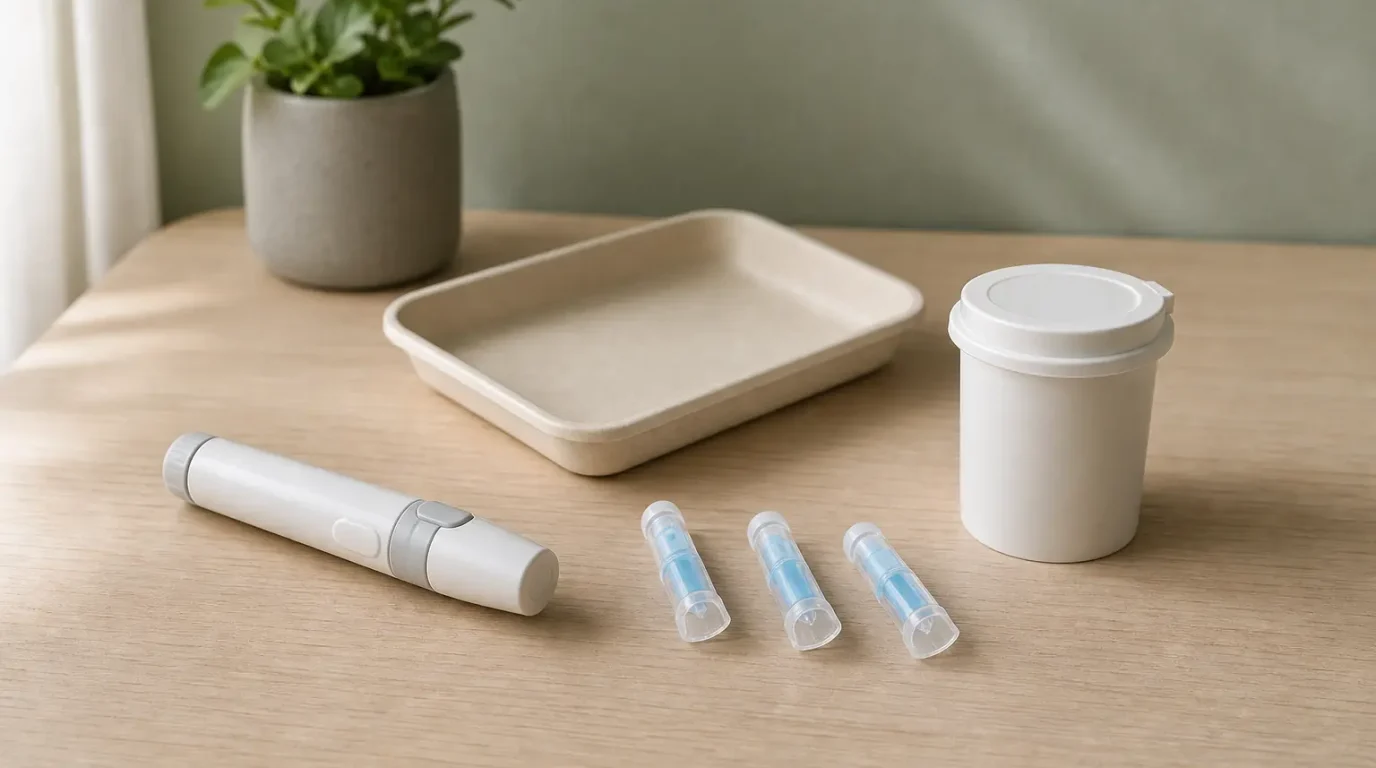
When you test your blood sugar at home, you prick your fingertip with a single-use lancet. Three rules keep testing clean and injury-free: wash and dry your hands, use a new lancet for every test, and put the used one straight into a puncture-proof container with a lid.
In Germany, the closed container is generally disposed of with residual waste; local rules may differ.
What is a lancet?
A lancet is a small, sharp instrument that pricks the skin to obtain a drop of blood for capillary blood glucose testing. It sits in the lancing device, the device that guides and triggers the needle. The blood glucose meter with its test strips then measures the value from the drop of blood. You handle these three parts differently: the lancet goes into the sharps container after each test, test strips go into residual waste, and the meter is disposed of as electrical equipment, depending on its design.
Used lancets are waste that carries a risk of injury and contact with blood. Loose in household waste, the paper bin or the yellow recycling bag, they can prick members of your household, children, cleaners and waste management workers.
How to test your blood sugar correctly
The order of steps before and after pricking your finger is crucial:
- Lay out the meter, test strips, lancing device and a new lancet.
- Wash your hands with soap and water and dry them completely.
- Prick the side of your fingertip and touch the drop of blood to the test strip.
- Remove the lancet using the ejection mechanism of the lancing device and put it straight into the sharps container.
Washing with soap removes traces of sugar, fat and protein from the skin that distort the result. Damp skin also dilutes the drop of blood. That is why drying your hands completely matters for accuracy, not just for hygiene. According to diabinfo, disinfectant is not necessary at home.
The best place to prick is the side of the fingertip. There are fewer nerves there, so the prick is usually less painful. Rotating the sites regularly is gentler on your skin.
If too little blood comes out, don’t squeeze or press. Pressing hard brings tissue fluid into the drop of blood and distorts the reading. It’s better to prick again at a different spot with a new lancet.
Every test needs a new lancet in the lancing device. A lancet that has already been used is blunter, the next prick hurts more, and the needle carries traces of blood.
For the same reason, you should not share your lancing device. A lancing device must not be used by more than one person, not even within a family and not even if a fresh lancet is inserted beforehand. Blood can remain on parts of the device and be transferred to another person the next time it is used. The US Food and Drug Administration (FDA) points out that cleaning and disinfecting reusable devices is error-prone in practice.
The term “reusable” on a lancing device means the device is intended for repeated testing by a single person. It does not mean that several people may use the same device.
A documented hepatitis B outbreak in an assisted living facility in North Carolina in 2010 shows how serious this risk is. Of 40 residents examined, eight fell ill, all of them had to be hospitalized, and six died. All of those affected were among the 15 people whose blood glucose testing had been assisted by staff. Among the 25 residents who were not assisted, there were no cases. This outbreak does not show a danger for normal self-testing at home, but it does demonstrate that shared testing equipment can transmit bloodborne infections. According to the CDC, in facilities where others help with testing, single-use safety lancets that retract permanently after the puncture should be used.
How to dispose of lancets correctly
Put the used lancet into a puncture-proof, re-closable container immediately after testing. A suitable container is one that doesn’t break and doesn’t leak. It must be possible to close it permanently, and children must not be able to open it. The safest option is a dedicated sharps container from a pharmacy or medical supply store. If you use an everyday container, choose only glass or hard plastic that meets these requirements. Never overfill the container, and keep it out of the reach of children and pets.
In Germany, the German Diabetes Association (DDG) recommends putting the closed container into residual waste. The DDG’s disposal sheet from August 2024 gives exactly this route for needles and sharp diabetes supplies: a puncture-proof, re-closable container, closed, in residual waste. The information from the National Diabetes Information Portal diabinfo gives the same basic rule for lancets. There is no nationwide uniform regulation, and individual municipalities or waste companies may have different requirements. If in doubt, ask your local waste disposal service, your pharmacy or your diabetes team.
Used lancets must never go loose into the trash. Household waste, the yellow bag or yellow bin, paper and organic waste, and the toilet are all unsuitable. Thin plastic bags or open cans are not suitable either.
Dispose of the other components of testing separately. According to the DDG and diabinfo, used test strips go into residual waste. Take batteries from the meter separately to a battery collection point. Electronic components such as a blood glucose meter or modern sensor and pump components are disposed of as waste electrical equipment, depending on the device. Paper and plastic packaging belongs in the usual recycling collection, provided it is clean.
What to do after a needlestick injury
If a used lancet has pierced your skin, wash the area immediately with soap and water. The same applies if blood has got into your eye, mouth or nose or onto broken skin. Then seek medical advice promptly and note the time and circumstances of the injury. Whether further measures are needed depends on whether the lancet was visibly contaminated with blood, how deep the puncture was and whether you know where the lancet came from. Do not ignore the injury, even if it looks small.