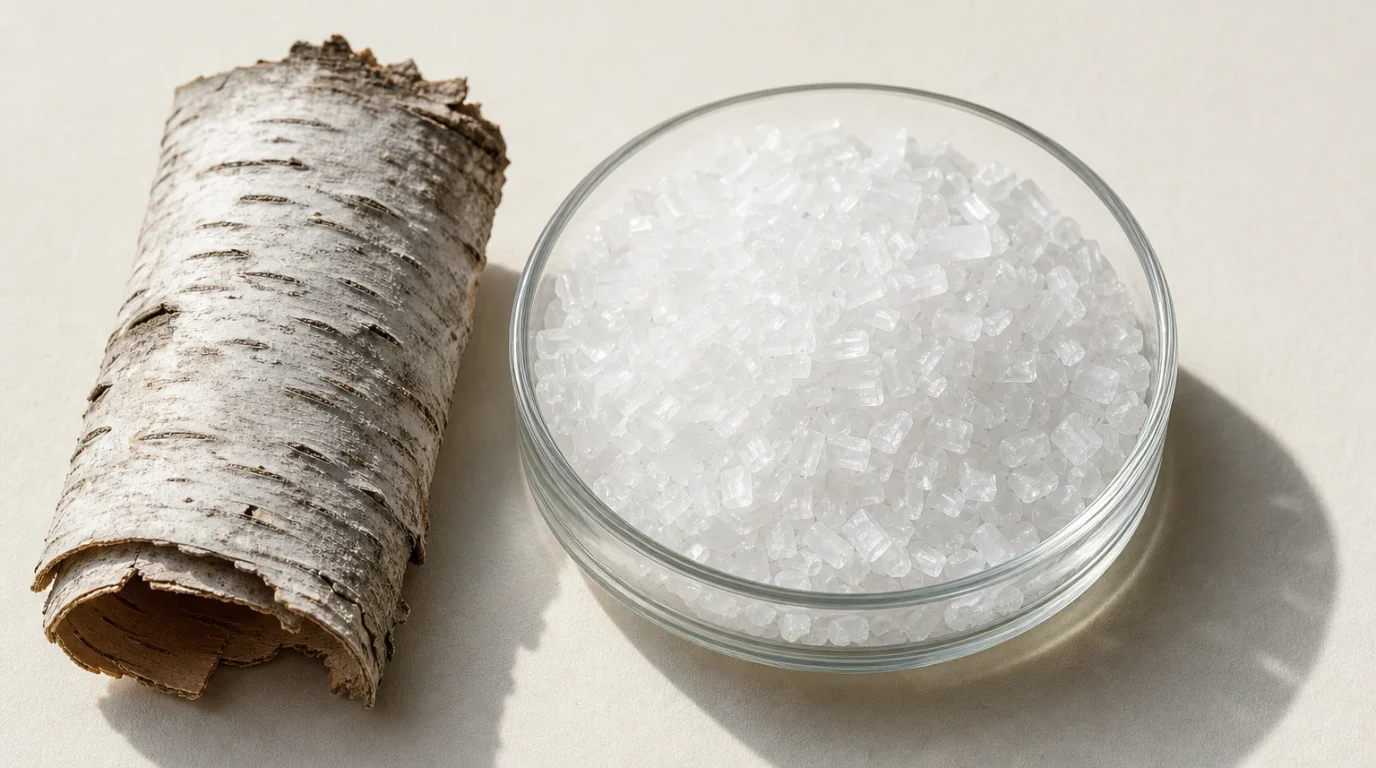
Xylitol, also known as birch sugar, is a sugar alcohol used in some sugar-free foods and as a substitute for table sugar. After a meal, blood sugar usually rises less with xylitol than with sugar. Even so, xylitol still affects blood sugar and insulin. It contains calories, can cause digestive problems, and has not been shown to be a treatment for diabetes.
How xylitol differs from table sugar
Xylitol tastes about as sweet as table sugar but contains less energy: for labeling in the EU, it is rated at 2.4 kilocalories per gram, compared with 4 kilocalories for sugar. The name “birch sugar” comes from the fact that xylitol used to be obtained from wood components. Today it is mostly made from other plant-based raw materials, such as corn cobs or cereal residues.
The body absorbs xylitol only partially in the small intestine. For this reason, blood sugar generally rises less after eating it than after glucose or sucrose, which is table sugar. How big the difference is depends, among other things, on the amount and on whether you eat xylitol on its own or as part of a meal.
What studies show about the effect on blood sugar
In a small study with eight healthy men, 25 grams of xylitol caused a much smaller rise in blood sugar and insulin than the same amount of glucose. The calculated glycemic index, which indicates a food’s effect on blood sugar compared with glucose, was 7 when glucose was set at 100. Another review arrived at a value of about 13. These figures do not allow reliable predictions for every person or every food. They are based on small studies. The measurement method, dose, and composition of the meal also influence the values.
There is also a small, older study in people with diabetes. In 14 people treated with insulin, a breakfast containing 30 grams of xylitol led to a blood sugar curve similar to that after a breakfast containing starch. After a breakfast with sucrose, blood sugar rose more sharply. This result describes a short-term response to a single meal. It does not show that xylitol improves diabetes control in the long term or generally reduces insulin requirements.
Other short-term studies show why xylitol should not be considered blood-sugar neutral. At the amounts studied, 7, 17, and 35 grams, blood sugar and insulin rose slightly with the dose. Overall, the studies show that when xylitol replaces sugar, blood sugar right after eating often rises less. They do not show, however, that it has a blood-sugar-lowering effect of its own.
What has not been shown for diabetes treatment
The available studies are not sufficient to show that xylitol improves HbA1c, the long-term blood sugar measure. Likewise, there is no evidence that xylitol prevents complications of diabetes, replaces medication, or has a therapeutic effect in type 1 or type 2 diabetes.
Studies of desserts for people with type 2 diabetes suggest that a dessert with a lower glycemic load causes a smaller rise in blood sugar after eating. The glycemic load takes into account both the effect on blood sugar and the amount of carbohydrates eaten. However, such desserts often differ not only in the sweetener but also in ingredients such as fiber and in total carbohydrate content. The contribution of xylitol alone cannot be determined reliably from this.
What to keep in mind when eating it
Blood sugar rises less mainly when xylitol replaces sugar. If it is eaten in addition to a diet that is already high in sugar, there is no corresponding benefit. For sugar-free cookies, chocolate, or desserts, check the full nutrition information: starch and other carbohydrates in the product can also affect blood sugar. “Sugar-free” therefore does not mean “carbohydrate-free.”
If you use insulin or blood-sugar-lowering medication, do not change your dose on your own because of a product containing xylitol. When you try a new food, you can occasionally measure your blood sugar to see how it responds.
Possible digestive problems
Because the small intestine absorbs xylitol only partially, some of it reaches the large intestine, where it can bind water and be fermented by gut bacteria. This can cause bloating, abdominal pain, loose stools, or diarrhea. How well people tolerate xylitol varies and also depends on the amount eaten.
In Germany, foods containing more than ten percent sugar alcohols must carry a notice that excessive consumption may have a laxative effect. No universal amount that everyone tolerates without problems can be derived from this. If you notice symptoms, reduce the portion or avoid the product.
What the 2024 cardiovascular study says
A study published in 2024 in the European Heart Journal found an association between higher xylitol levels in the blood and an increased risk of major cardiovascular events. In the group studied with the highest blood level, the calculated risk was about 57 percent higher than in the group with the lowest level. The researchers studied people who were at cardiovascular risk. The results therefore cannot simply be applied to the general population.
The study does not show that eating xylitol causes heart attacks or strokes. The blood levels measured do not clearly show how much xylitol the participants had consumed in food. They also do not prove that xylitol was the cause of the events observed. In an additional experiment with ten healthy volunteers, a drink containing 30 grams of xylitol increased the reactivity of platelets. However, heart attacks and strokes were not examined. The results are a safety signal and call for further research. They do not show that usual amounts of xylitol cause cardiovascular disease.
Conclusion
Xylitol can replace table sugar and reduce the rise in blood sugar after eating. It provides calories and can affect blood sugar. Pay attention to a product’s overall composition and portion size, and take possible digestive problems into account. So far, there is no evidence that xylitol improves long-term diabetes control.