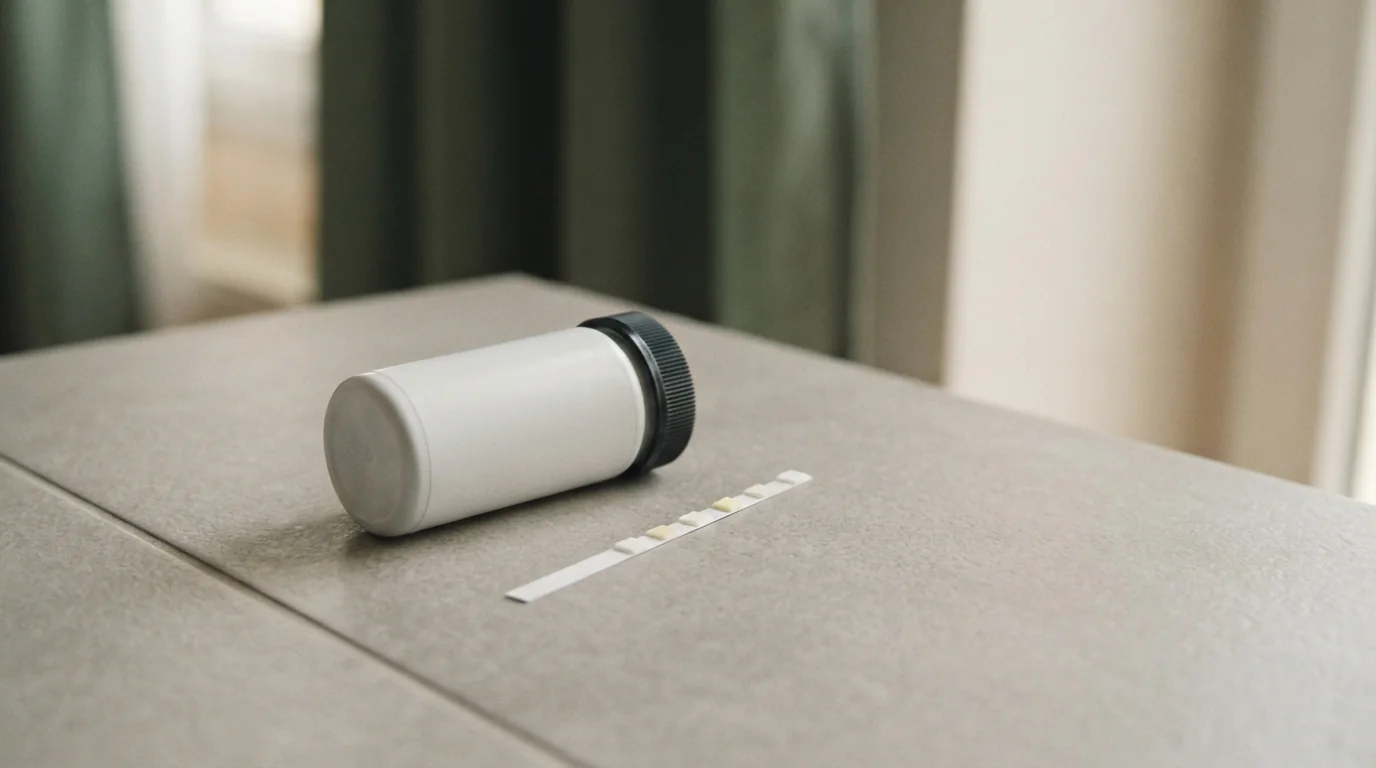
“Urinstix” is the colloquial German term for urine test strips (reagent strips). These are plastic strips with colored pads that change color on contact with urine, thereby detecting certain substances. They are fast and inexpensive, and deliver a result within a few minutes. A urine dipstick is a screening test, not a diagnostic device. It flags abnormalities that must be confirmed with more precise tests. This applies especially to diabetes, kidney disease and urinary tract infections.
What Urine Test Strips Measure
Depending on the product, urine test strips check different parameters. The most common are glucose, ketone bodies, protein, blood, white blood cells (leukocytes), nitrite, pH, specific gravity, as well as bilirubin and urobilinogen. The colored pads react semi-quantitatively: the user compares the changed pads with the manufacturer’s color chart and reads off whether a value is normal, elevated or markedly elevated.
Every parameter has its limits. A positive glucose pad indicates that blood sugar was above the renal threshold, usually around 10 mmol/l or 180 mg/dl. However, it does not provide a current blood glucose value. A negative result does not prove that blood sugar is normal. The same applies to ketones: most strips react to acetoacetate but not to beta-hydroxybutyrate, which is often the predominant ketone body in diabetic ketoacidosis. A urine dipstick can therefore underestimate the actual ketone burden.
Urine Dipsticks in Diabetes
Urine dipsticks are no longer intended for daily blood glucose monitoring. The American Diabetes Association does not recommend urine glucose tests for routine diabetes management because they do not accurately reflect plasma glucose levels. The urine glucose value is an average since the last time the person urinated and says nothing about current blood sugar. Where blood glucose measurement is not possible, for example in low-resource settings, the urine test may retain a limited role.
Ketones are a different matter. People at increased risk of ketoacidosis should check their ketones when blood sugar is unexplainedly high or when they have symptoms such as nausea and abdominal pain. This includes many people with type 1 diabetes, people who have previously had ketoacidosis, and people taking SGLT2 inhibitors. Blood ketone measurement is the preferred method because it directly detects beta-hydroxybutyrate. Urine ketone strips are a practical alternative if blood measurement is not available.
A positive ketone result together with vomiting, abdominal pain, deep or rapid breathing, confusion or dehydration is an emergency. Diabetic ketoacidosis can worsen quickly and requires medical treatment, not self-monitoring with a test strip.
Kidney Disease and Protein Testing
A urine dipstick can reveal larger amounts of protein in the urine. For the early detection of diabetic kidney disease, however, this is not enough. The standard protein pads are too insensitive to reliably detect early albuminuria. Instead, measuring the urine albumin-to-creatinine ratio, or UACR for short, is recommended. This puts the amount of albumin in relation to creatinine, which compensates for fluctuations caused by dilute or concentrated urine.
A positive protein pad therefore only means: get it checked. It is not a confirmation of kidney disease. Even a single abnormal value is not enough to diagnose chronic kidney disease, because biological and analytical variation can produce false signals. The KDIGO kidney guideline recommends confirming positive findings and using first morning urine for albumin measurement. Validated semi-quantitative albumin-creatinine strips now exist and may be suitable for screening when laboratory measurement is not available. Ordinary multi-parameter strips are not among them.
Urine Dipsticks in Urinary Tract Infections
When a bladder infection is suspected, the leukocyte esterase and nitrite pads are the ones mainly used. Leukocyte esterase indicates white blood cells, and nitrite indicates bacteria that convert nitrate to nitrite. The European Association of Urology gives only a weak recommendation for urine testing in acute cystitis. In women with typical symptoms and no vaginal symptoms, the medical history alone can largely establish whether cystitis is present. The test strip is mainly helpful when the diagnosis is unclear.
Accuracy depends heavily on the group being tested. Nitrite is fairly specific but insensitive: in older reviews, sensitivity was often limited, while specificity was higher. This means a negative nitrite pad does not rule out an infection. A negative result for nitrite and leukocyte esterase together can reduce the likelihood of infection in certain groups.
In older people, the informative value is considerably more limited. A systematic review from 2026 found a sensitivity of 90 percent but a specificity of only 56 percent for detecting bacteriuria in people aged 60 and over. In symptomatic older adults, specificity dropped to 39 percent. The reason: bacteria in the urine without signs of infection, known as asymptomatic bacteriuria, are common in this age group. A positive strip then says little about whether there is truly an infection that needs treatment. A urine dipstick is therefore not a simple yes-or-no test for urinary tract infections; its result must always be interpreted in the context of symptoms and patient group.
Using Urine Dipsticks Correctly
The exact instructions are in the package insert of the respective product. The basic steps are the same for most strips. You collect fresh urine in a clean, dry container, mix the urine well, check the expiry date, take out one strip and close the tube again immediately. Do not touch the colored pads; briefly dip all pads into the urine and remove the strip immediately. The reaction time then runs, after which the pads are compared with the color chart. Reading should be done in good light and at the specified time, because reading too early or too late distorts the result.
For testing for a urinary tract infection, midstream urine is usually recommended. You let the first stream of urine go into the toilet, collect the middle part in a clean container and avoid touching the inside of the container. This reduces contamination by germs from the genital area.
Storage of the strips is a common source of error. Unused strips belong in the original bottle, must be stored at 15 to 30 degrees Celsius and must not be exposed to direct sunlight or moisture. The desiccant must stay in the bottle. Expired strips are unusable. Ketone reagents can also spoil on contact with air and then produce false-negative results.
Typical Sources of Error
False-negative results are caused by expired strips or strips stored in damp conditions, incorrect reading time, highly acidic urine or high vitamin C intake. Vitamin C interferes with some reactions. For nitrite, bacteria without nitrate reductase do not produce a positive signal, and if urine stays in the bladder for too short a time, the chance of detection is reduced. Ketones can be broken down by microorganisms if urine is stored for a longer time.
False-positive or nonspecific findings have other causes: contaminated containers, menstrual blood, concentrated urine, physical exertion or fever. Physical exertion and fever temporarily increase protein excretion. Medications and dyes can also interfere with color interpretation. Ketones occur not only in ketoacidosis but also during fasting, starvation and pregnancy. Up to 30 percent of morning urine samples from pregnant women can contain ketones without diabetic ketoacidosis being present.
An abnormal result is a signal for further evaluation, not a diagnosis. A normal result does not reliably rule out a disease. Anyone who is unsure about symptoms should seek medical advice rather than relying on the strip alone.