For diabetes content, you need several kinds of sources: guidelines give recommendations on care, PubMed helps you find journal articles, trial registries provide information on studies, and the Robert Koch Institute (RKI) publishes health data. Each source is based on its own data foundation.
Note which statement you are checking, which group it applies to and how up to date the source is. This lets you clearly distinguish in your text between established findings, open questions and decisions for individual patients.
Start with guidelines
When it comes to care in Germany, the National Disease Management Guideline (NVL) Type 2 Diabetes is a good starting point. Its version 3 was published on 15 May 2023 and, according to the guideline page, is valid until 15 May 2028. The NVL is revised chapter by chapter. Before you begin your research, therefore, check whether a newer chapter or version exists for your topic.
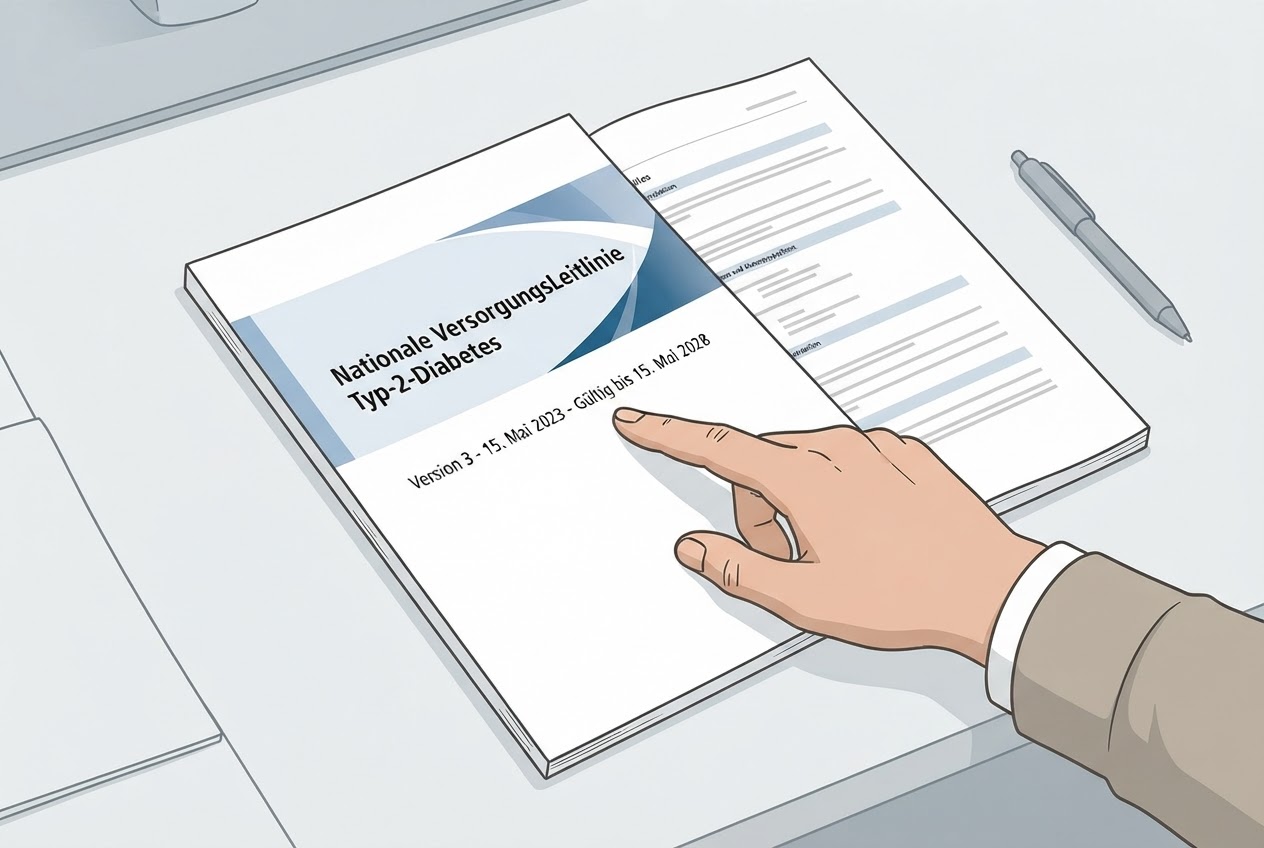
In addition to the short version, read the long version and the guideline report. The report describes how experts assessed the scientific evidence and agreed on recommendations. Read the report especially when the certainty of the evidence behind a recommendation matters or when professional societies assess the situation differently. The NVL also points out that only the documents provided on its website count as authorized versions.
The DDG practice recommendations complement the NVL, but they do not necessarily answer the same question. The German Diabetes Society (DDG) publishes annual recommendations; the 2025 edition took into account, among other things, new randomized trials and meta-analyses. For each recommendation, note the document name, the year, the target group and the area it applies to. This helps you avoid applying a statement about type 2 diabetes to type 1 diabetes or to all people with diabetes.
Search for studies in a targeted way
PubMed lets you search for biomedical journal articles free of charge. According to the US National Library of Medicine, PubMed contains more than 40 million citations and abstracts. However, PubMed does not provide the full text for every result. Filters for date, language and publication type can narrow your search. But you may miss relevant work if an entry has not yet been fully indexed in PubMed. Record your search terms, date and filters instead of treating filters as proof of a complete search.

Cochrane reviews summarize studies on a health question using a fixed procedure. This lets you view individual studies in the context of the research as a whole. Check which population and which health outcomes the review examines, which studies it includes and whether its search is still current enough for your question. A review does not necessarily answer a more narrowly defined editorial question.
Start with a precise question. Decide whether it concerns diagnosis, prevention, treatment, everyday life or care. Also specify which type of diabetes, which age group or which risk group is involved, what you are comparing against and which time period you are looking at. For an article on early detection, for example, it matters whether the topic is systematic testing of the whole population (screening) or testing of people at increased risk.
Understanding trial registries correctly
ClinicalTrials.gov and the European clinical trials information system CTIS show information on ongoing or completed clinical trials. CTIS contains public information on EU and EEA trials, such as the trial number, sponsor and recruitment or study periods. For certain trials that began under older EU law before 31 January 2023, the European Medicines Agency refers to the EU Clinical Trials Register.
A registry entry describes a trial but does not, on its own, prove that a treatment works. Look for published results and check whether they answer your question. Pay attention to the group studied, the comparison and the health outcomes measured. Even a positive result does not automatically tell you whether it applies to other groups or what it means for individual readers.
Checking diabetes figures from Germany
Data from the RKI’s diabetes surveillance help you put statements about population health into context. For the period 2015 to 2024, the surveillance covered 40 indicators or indicator groups in four fields of action. The fact sheets explain how the respective data were obtained. However, a project period does not automatically mean that every indicator will continue to be updated in the same form afterwards.
For each figure, note at least the reference year, the group studied, the definition and the method of data collection. A diagnosis recorded in billing data cannot be directly compared with information a person gave themselves in a survey. Likewise, figures on the number of people with diabetes must not be equated without checking if they cover different types of diabetes or survey periods. The DDG practice recommendation 2025 cites at least 9.1 million people with documented type 2 diabetes in Germany for 2024. Use this figure only with this definition and reference year.
If two sources give different figures for the share of people with diabetes in the population, do not calculate a supposedly uniform value from them. Instead, explain what the figures are based on and why they may differ. For the sources described here, there is no fully harmonized comparison that makes surveys, routine data and other estimates conclusively comparable for the same period.
Recording statements in a source matrix
A source matrix lets you record which sources support the statements in your final text. This shows you whether a statement is based on a guideline, a single study, a review, a registry or population statistics. You can use this template to check every key statement:

| Check item | Entry |
|---|---|
| Statement to be checked | |
| Target group and type of diabetes | |
| Source and document type | |
| Version, publication date and access date | |
| Population, comparison and time period | |
| Endpoint and result | |
| Uncertainty and limitations | |
| Funding or conflicts of interest according to the source | |
| Planned wording | |
| Open query |
For a figure, also note what is being counted and which group forms the denominator. Also record how the data were collected. For a statement about a treatment, check whether the text correctly describes benefit, possible harms and uncertainty. The wording must not be stronger than the underlying source.
Describing uncertainty clearly
Distinguish between a lack of evidence for a benefit and evidence that there is no benefit. The NVL shows this difference for screening for type 2 diabetes: for systematic screening of the population, the structured search found no evidence of a benefit for long-term outcomes that matter to patients. According to the guideline, the scientific evidence was not sufficient to conclusively answer the question for screening in people at risk. A general statement such as “screening works” or “screening doesn’t work” would obscure this difference.
Also explain when recommendations differ from one another. Check whether they concern the same group and the same purpose and are based on the same scientific evidence. Differences can arise because the recommendations apply to different areas or because experts assess a limited number of studies differently. If the evidence remains open, state that uncertainty instead of constructing a clear-cut answer.
Writing clearly and safely
For the language review, you can use the Good Practice Health Information (Gute Praxis Gesundheitsinformation) of the German Network for Evidence-Based Medicine as a guide. It helps you create clear, well-checked health information. It does not replace a guideline specific to diabetes. Gesundheitsinformation.de, published by the Institute for Quality and Efficiency in Health Care (IQWiG), is another example of independent, evidence-based information for the public.
Explain technical terms the first time you use them, and make clear who a statement applies to. Avoid wording that blames people for their condition or derives a personal recommendation from a general study result. A health editorial team informs, but it does not make diagnoses, state individual dosages or tell anyone to start, stop or change a treatment. For acute risks, the text must state clearly when medical help is needed or when to call the emergency number.
Checking before publication
Shortly before publication, check once more the guideline versions you used and the continuously updated study registries. Record the date you accessed them. Also check whether the cited source supports the key statement, whether figures appear with their reference year and data basis, and whether open questions about the evidence remain visible. For regularly updated practice recommendations, the version check is part of the final edit.