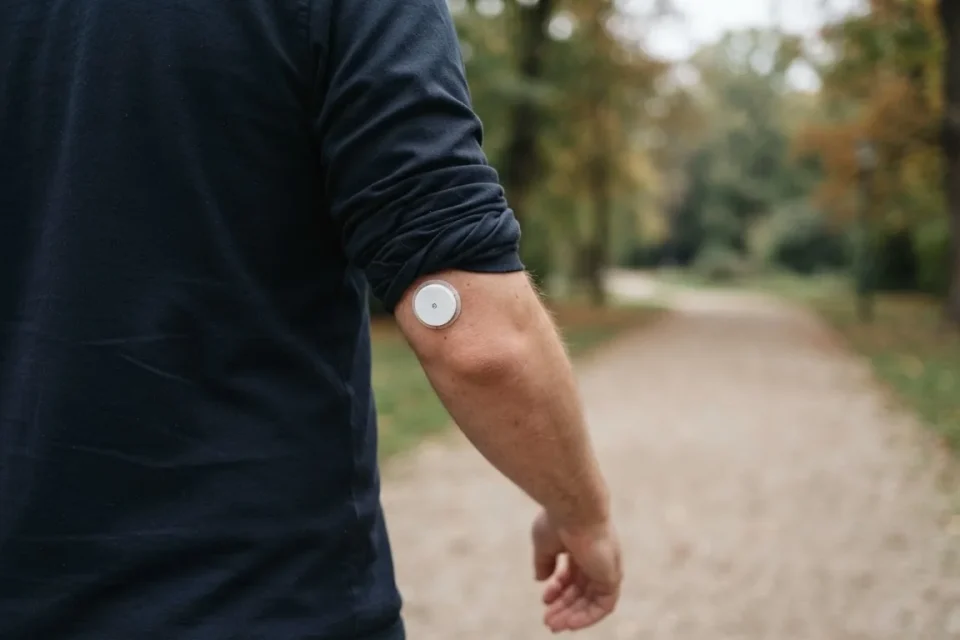
“Measuring blood sugar with a chip” is an umbrella term, usually referring to continuous glucose monitoring (CGM) systems. A small sensor under the skin continuously sends readings to a receiving device. It measures the glucose in the interstitial fluid, not the blood sugar directly. The readings can lag behind the blood value, especially when sugar levels change quickly.
What a Glucose Chip Actually Measures
A CGM system consists of three parts: the sensor, a transmitter and a receiving unit such as a smartphone, reader or insulin pump. In the most widely used systems, an applicator inserts a thin filament into the subcutaneous fatty tissue. There, the sensor records the glucose concentration in the interstitial fluid, i.e. the tissue fluid, and transmits the data at short intervals. Depending on the product, the sensor is usually replaced after 7 to 15 days.
The difference from traditional blood glucose measurement is fundamental. With a finger prick, a drop of capillary blood is placed on a test strip, providing a snapshot of blood sugar. The sensor’s tissue value lags behind the blood value. The German information portal diabinfo gives roughly ten minutes as a typical order of magnitude. With rapid changes, for example after eating or during exercise, the deviations can be larger.
What Continuous Measurement Offers
The benefit of a CGM is that it shows the trend. A single reading is no more accurate than a blood measurement. The system shows not just a current value. It also shows whether glucose is rising or falling, how the curve develops over hours and whether critical values are imminent. Nighttime hypoglycemia becomes visible. Alarms can warn of high or low values. Treatment decisions can rely more on trends than on individual measurements.
The Robert Koch Institute describes CGM as a minimally invasive measurement method in which glucose is measured in the interstitial fluid and transmitted continuously or intermittently to a receiving device. Among children and adolescents with type 1 diabetes in Germany, almost 95 percent used a CGM system in 2022. In its 2026 Standards of Care, the American Diabetes Association recommends offering CGM to people with diabetes early on and thereafter in line with individual benefit and preferences. At the same time, it stresses that users should continue to have access to a blood glucose meter, for example in cases of conflicting symptoms, technical problems, calibration or rapid glucose changes.
Implantable Sensors for Longer Wear
Alongside sensors that are replaced every one to two weeks, there are implantable systems. In these, medical professionals insert the sensor under the skin, where it remains for several months. The transmitter still sits on the outside of the skin and sends the measurement data to an app or a receiving device.
The Eversense system is the main commercially available example. In 2018, the US FDA approved the first CGM system with a fully implantable glucose sensor for adults with diabetes. That version was designed for up to 90 days. The FDA cleared the current Eversense 365 on September 16, 2024. It is approved in the US for up to 365 days. For Europe, the manufacturer announced CE marking in January 2026 and said it would launch in Germany, Italy, Spain and Sweden. Whether the system is widely available in Germany at the time of this publication cannot be independently confirmed. Anyone who wants to use it must check current availability and reimbursement with the manufacturer, healthcare providers and their health insurer.
How Accurate Are the Systems?
Accuracy is not the same across all glucose ranges. The FDA documents for the Eversense 365 describe a clinical evaluation with 110 study participants. The study visits ran through day 365. Across the entire measurement range of 40 to 400 mg/dl, 92.0 percent of values were within 20 percent or 20 mg/dl of the reference method.
The mean absolute relative difference (MARD) compared with a reference measurement shows the differences between ranges. Below 54 mg/dl it was 17.9 percent, in the range of 54 to 69 mg/dl 11.1 percent, from 70 to 180 mg/dl 9.0 percent, from 181 to 250 mg/dl 7.7 percent and above 250 mg/dl 7.2 percent. The reported deviation was larger especially in the very low range below 54 mg/dl. These figures come from a regulatory device assessment of the Eversense 365 and do not necessarily apply to other CGM systems.
Limitations and Risks of CGM Sensors
An implanted sensor does not eliminate all the problems of glucose measurement. The sensor must be inserted by trained personnel and later removed or replaced. The frequent replacement of a skin sensor is no longer necessary, but a minor medical procedure is required instead. As part of the approval, the FDA assessed both the safety of the sensor and the implantation procedure.
Because CGM systems measure tissue glucose, a reading should not be interpreted in isolation, especially if it does not match symptoms. Calibration also remains part of everyday life. The Eversense 365 was advertised with reduced calibration. According to the manufacturer, weekly calibration is planned after an initial phase. The specific calibration and verification requirements depend on the product and software and are set out in the respective instructions for use.
For long-term implanted sensors, the tissue’s reaction is also a central technical challenge. Scar or inflammatory tissue can affect signal quality, stability and lifespan. The scientific literature cites biocompatibility, sensor drift and signal stability as key development problems.
Alarms also have a downside. They can be helpful, but they can also disrupt sleep and daily life. Frequent false alarms or constant preoccupation with numbers can cause stress. Skin irritation, technical failures or detachment of the external transmitter remain possible.
Non-Invasive Chips Are Still in Research
There is repeated talk of chips in rings, wristbands or smartphones that are supposed to measure blood sugar without breaking the skin. Optical methods, spectroscopy and measurements via skin, breath or saliva are being investigated. Reviews, however, reach a cautious conclusion. There are many research approaches, but only a few non-invasive systems that have been adequately validated in clinically relevant situations and established from a regulatory standpoint. The difficulties include very low glucose concentrations, skin color and thickness, temperature, blood flow, movement, sweat and moisture.
An approved, widely established non-invasive method with the reliability of traditional blood or CGM systems is not documented in the sources researched. Anyone who buys a “blood sugar chip” today will in practice receive a CGM sensor or an implant, not a device that works without any intervention.
Who Benefits from Measuring
For many people with diabetes, CGM is an established part of treatment, especially when insulin is injected and the risk of hypoglycemia is high. The situation is different for people without diabetes. A summary published in JAMA Internal Medicine in 2026 concludes that there is no good evidence that CGM improves health or prevents diabetes in healthy people. Even for people with diabetes, there is no direct evidence that wearing a CGM generally prevents long-term complications or severe hypoglycemia compared with usual care. The authors also point out that a strong fixation on individual glucose values can lead to unnecessary dietary restrictions.
The benefit therefore depends on the target group, the therapy, the risk of hypoglycemia and training. A CGM shows how glucose levels change after meals, exercise or sleep. This does not automatically lead to a health benefit.