The number of people with diagnosed type 2 diabetes in Germany is likely to rise by 2050. How much depends on how new cases, mortality and the population develop. For a scenario with constant rates of new cases and constant excess mortality due to diabetes, the Robert Koch Institute (RKI) calculates around 11 million people affected. This is a model calculation whose result depends on certain assumptions and is not a definitive forecast.
Prevalence indicates how many people are living with a disease at a given point in time. Incidence refers to the number of new cases in a period of time. The two figures show different aspects: prevalence can rise even if incidence does not increase, for example when people live longer with diabetes.
The number of people living with diabetes and the number of new cases describe different trends.
How many people could be affected in 2050?
For 2022, the RKI estimates the number of adults with diagnosed type 2 diabetes at 6.05 million. That corresponded to 8.6 percent of the adult population. For 2050, the figures differ considerably depending on the model assumption:
| Assumption for the model calculation | People affected in 2050 | Share of the population |
|---|---|---|
| Rate of new cases and excess mortality due to diabetes remain constant | 11.01 million | 16.1 percent |
| Rate of new cases falls by 2 percent per year | 8.39 million | 12.2 percent |
| Rate of new cases and excess mortality due to diabetes fall by 2 percent per year | 8.94 million | 13.0 percent |
Excess mortality due to diabetes means that people with diabetes die more often than people without diabetes. If this excess mortality falls, more people affected live longer with the condition. That is why the number of people with diabetes can be higher even though the rate of new cases falls.
Other RKI model variants for 2050 range from around 7.4 to 15.3 million people affected. The wide range shows that the results depend heavily on the assumptions the model is based on. The calculations also take the expected population trends into account.
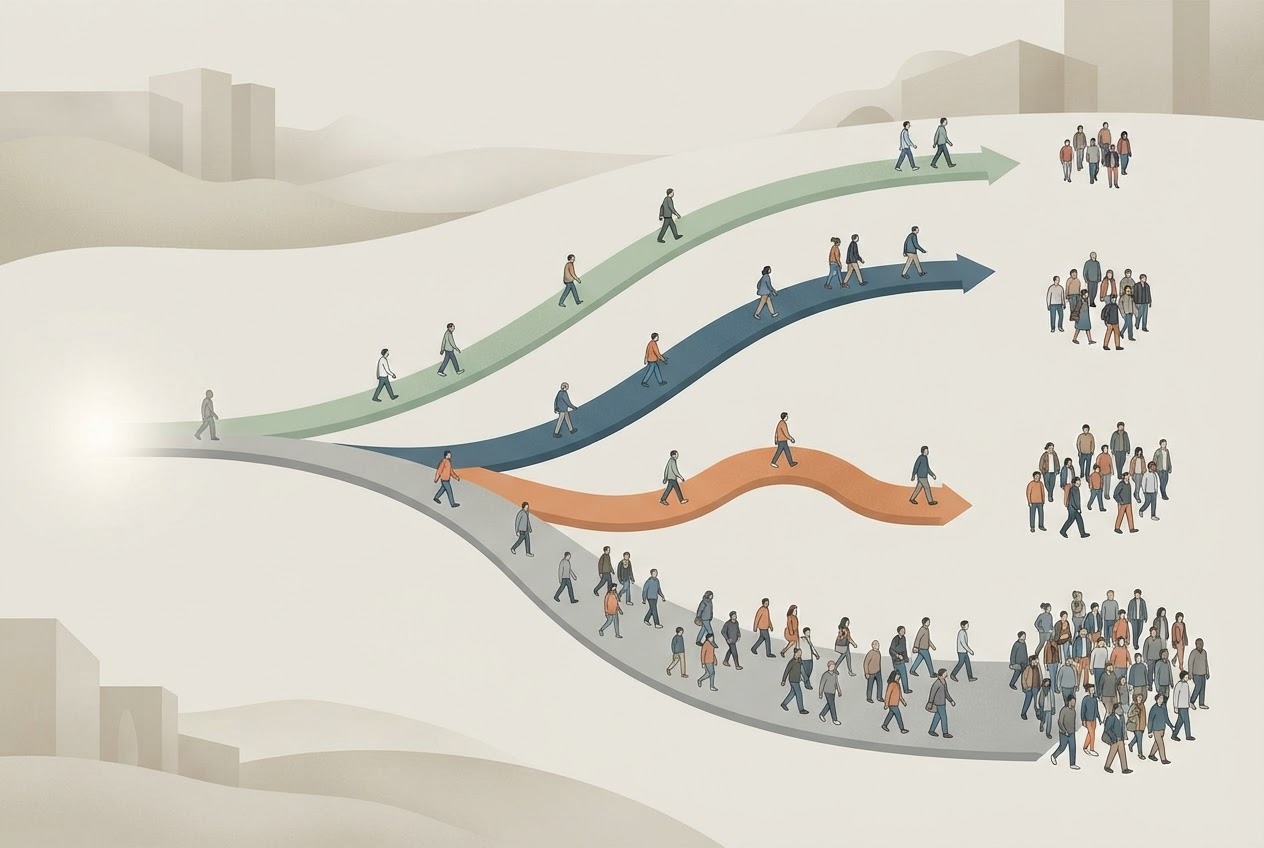
The projections differ because the models assume different developments in new cases and mortality.
Why projections differ
Another modeling study estimates different numbers of people affected for 2040, depending on the scenario. In a scenario with constant prevalence, it would be 8.1 million people. The researchers extrapolated observed trends in new cases over different time periods. The results are not directly comparable with the RKI projections. The models refer to different time periods and are based on different assumptions.
Changes in recorded diagnoses also make it harder to interpret the trend. An RKI analysis of billing data initially showed falling rates of new cases. During the pandemic, recorded diagnoses declined further and then rose again. Fewer doctor visits may have meant that diabetes was detected later. Part of the later increase may therefore be due to delayed diagnoses. The recorded figures do not prove that the actual risk of developing the disease changed to the same extent.
What the current figures show about diabetes
In an RKI survey, 10.3 percent of adults reported for 2024 that they had been diagnosed with diabetes by a doctor. The analysis excluded gestational diabetes. In 2003, the share had been 5.8 percent. The survey covers all forms of diabetes, not just type 2. More than 90 percent of people with diabetes have type 2. Even so, the overall figures do not show exactly how type 2 diabetes alone has developed. In addition, the survey and the RKI projection are based on different methods.
Even after accounting for age structure, the share of known diabetes rose: from 6.0 percent in 2003 to 9.7 percent in 2024. This method is called age standardization. It adjusts for differences in age structure, making comparison possible. As possible reasons for the increase, the RKI cites an aging population, longer life with diabetes and changed diagnostic criteria.
Current representative data on undiagnosed diabetes are lacking. The number of diagnosed cases therefore does not capture everyone who is actually affected.
What the projections mean for care and personal risk
Projections of the number of people affected help with planning screening. They also support the planning of treatment and long-term care. If more people are living with diabetes, the need for appropriate medical care rises. Social differences also play a role here: RKI data show that known diabetes was more common in 2024 among people with a lower level of education than among people with a medium or higher level of education. Prevention and care should take these differences into account.

Your personal risk cannot be read precisely from a projection for Germany as a whole. If you are worried about possible symptoms or your risk, bring it up at a doctor’s appointment and clarify whether an examination makes sense. The population models do not allow conclusions about how many cases a particular measure would prevent by 2050.