If you write about diabetes for a German-language health newsroom, you need different kinds of evidence depending on the question. Guidelines help with treatment recommendations, while data from the Robert Koch Institute help with population figures. Systematic reviews summarize several studies according to fixed rules and help answer questions about benefits and harms. Evidence-based means backing up statements with traceable research and showing how certain the results are.

For each statement, note the source you used in an evidence matrix, a table that records the evidence and open points to check. This shows you which type of diabetes and which group of people the statement applies to, how up to date it is, and where individual medical decision-making begins.
Choosing sources for diabetes questions
For questions about treatment or care in Germany, it is best to start with the National Disease Management Guideline (NVL) on type 2 diabetes. It brings together recommendations for the treatment and care of people with type 2 diabetes. The version of the guideline listed was published on 15 May 2023 and, according to the AWMF, is valid until 14 May 2028. Even so, check the current register entry before you publish. The guideline does not automatically apply to type 1 diabetes, pregnancy or children.
For other topics, you will find suitable recommendations in the AWMF register and in the guideline overview from diabinfo. For every guideline, check the version, the target group and whether it is still valid. An overview page makes searching easier, but it does not replace checking the text of the guideline itself.
For statements about how common diabetes is in Germany, the Robert Koch Institute (RKI) is the right place to turn. For every figure, note the year of the data, the population studied and the definition used. A self-reported medical diagnosis answers a different question than a lab test for previously undetected diabetes.
Gesundheitsinformation.de, from the Institute for Quality and Efficiency in Health Care (IQWiG), explains health topics in an easy-to-understand way. The site shows how benefits, harms and uncertainty can be presented to lay readers. Pay attention to the clear language and the structure. Also check the update date and the evidence cited.
Systematic reviews help assess individual effects. They summarize several studies using a predefined method. Cochrane reviews and the Cochrane Handbook help you make sense of the results. With GRADEpro GDT, you can record important outcomes, meaning the results measured in the studies, and the certainty of the evidence in tables. Still, check whether the people studied, the treatments and the comparison groups fit your editorial question.
Tailoring your research to the question
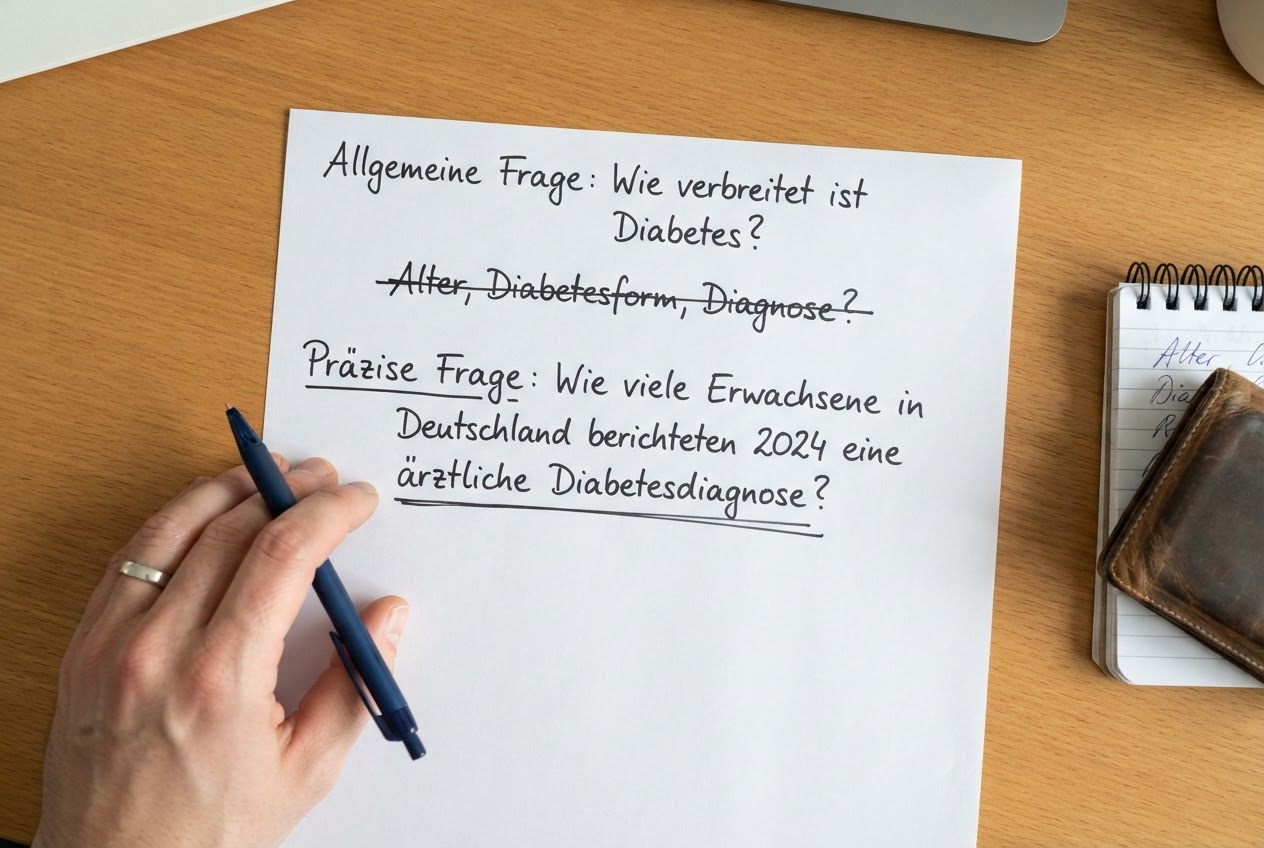
Start by formulating a specific question. “How common is diabetes?” leaves open which type of diabetes, which age group and which kind of diagnosis is meant. A more precise question would be, for example: “How many adults in Germany reported a medical diabetes diagnosis in 2024?” With this question, you can search specifically for a suitable RKI analysis.
For a question about treatment, first check the relevant guideline. Then look at systematic reviews and, if needed, the individual studies they include. A single study abstract is not enough to describe the full benefit and possible harms of a treatment.
Also note who produced or funded a source and which conflicts of interest are declared. Manufacturer information can, for example, explain how a product works. On its own, however, it should not support the claim that the product has a particular health benefit.
Putting diabetes figures in context
The RKI reported for 2024 that 10.3 percent of adults aged 18 and over said they had received a medical diabetes diagnosis. Gestational diabetes was excluded from this indicator. The figure describes diagnosed diabetes based on self-reporting, not all people with diabetes, including previously undetected cases.
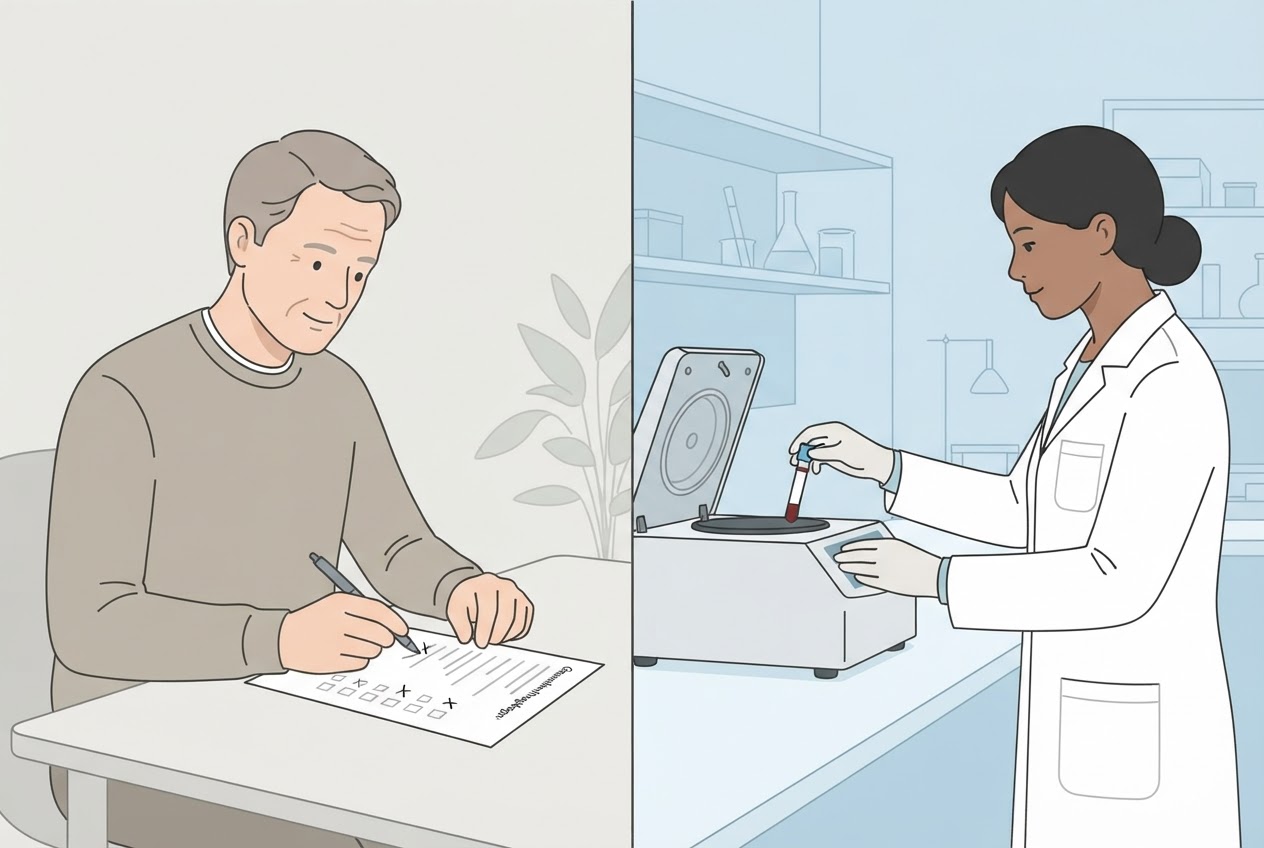
Another RKI analysis, based on the European Health Interview Survey (EHIS) 2018–2020, reports an age-standardized prevalence for Germany, meaning a share adjusted to the age structure, of 8.4 percent. The two figures cannot be compared directly: they are based on different survey periods and data sources. In age standardization, results are mathematically adjusted to the same age structure so that populations can be compared more easily. This does not, however, turn the figures into identical measurements.
A comparison over time also needs context. The RKI describes an increase in known diabetes from 5.8 percent in 2003 to 10.3 percent in 2024. After age standardization, the increase was smaller. Among the possible contributing factors, the RKI cites an aging population, changed diagnostic criteria and better care. An editorial team should therefore not conclude from this alone that the risk of developing the disease has changed or that a single behavior is responsible.
For projections, also state the assumptions the figures are based on. An RKI model estimates a share of 16.1 percent, or 11.01 million people, for 2050 if the number of new cases (incidence) and excess mortality stay the same. Excess mortality means that more people die than would be expected based on the comparison data. If the assumption is that incidence falls by 2.0 percent per year, the model gives 12.2 percent, or 8.39 million. These are scenarios, not guaranteed predictions.
Weighing the benefits and harms of diabetes treatments
When making statements about a treatment, check both the desired and the undesired effects. Pay attention to which outcomes the studies measured (endpoints), what they compared the treatment with and how long they followed the participants. Absolute figures show how many people in a group experience an outcome. Relative figures show the change compared with another group. The two answer different questions and do not mean the same thing.
GRADE is an approach for assessing how certain the evidence for an outcome is. A Cochrane summary takes into account, among other things, important endpoints, the effect and the certainty of the evidence. Adopt a rating only if the source states it or your editorial team has made one itself on a sound methodological basis.
Also distinguish between a lack of evidence and evidence that an effect does not occur. If an effect has not been studied sufficiently, it cannot automatically be concluded that it does not exist. State precisely what the data show and what remains open.
Setting up an evidence matrix for diabetes articles
A table shows which evidence supports a key statement and what you still need to check. Create a row for each important statement:
| Field to check | Entry |
|---|---|
| Editorial question | What should the text answer? |
| Statement in the draft | What is the intended sentence? |
| Population and context | Which type of diabetes, age group and country are meant? |
| Source and source type | Guideline, RKI analysis, systematic review or individual study |
| Date and version | When was the source published, and how current is it? |
| Result | Which effect or proportion was reported, and for what period? |
| Limitations and uncertainty | What limitations does the source state? |
| Funding and interests | Who produced or funded the source? |
| Defensible wording | How can the result be expressed without exaggeration? |
| Next check | Is a current guideline, a comparison group or a follow-up query missing? |
The matrix documents your review but does not replace your own GRADE assessment. It helps you spot overstated wording. If the source examines only a specific group, the text must not extend the statement to all people with diabetes.
Check diabetes articles before publication
Check clinical statements against the relevant guideline and verify that it is still valid. For statistics, the data year, the population studied and the definition must be clear. Make sure that benefits, harms and uncertainty are presented in a balanced way and that the text does not state anything more strongly than the evidence supports.
Health information should also clearly state who wrote and published it, which sources were used, which conflicts of interest exist and when the content was last updated. The guideline for evidence-based health information offers methodological guidance on this. Its version 1.0 dates from 2017 and, according to the publisher’s page, is being updated. IQWiG published its General Methods on 19 December 2025. Check separately whether the methods are current and whether the specific medical statement is still correct.
Then read the finished text from the perspective of someone without medical training. Explain technical terms the first time you use them and clearly separate general information from medical decisions. An independent editorial team should not make diagnoses, give individual dosages or instruct readers to start, stop or change a treatment. If the text deals with an acute risk, state clearly when medical help is needed and when to call the local emergency number in a life-threatening emergency.