In 2024, at least 9.1 million people in Germany were living with documented type 2 diabetes. The most important developments of 2025 concern more than blood sugar: in type 2, protecting the heart and kidneys is moving more into focus. In type 1, automated insulin delivery systems improve glucose control, although real-world data also raise safety questions.
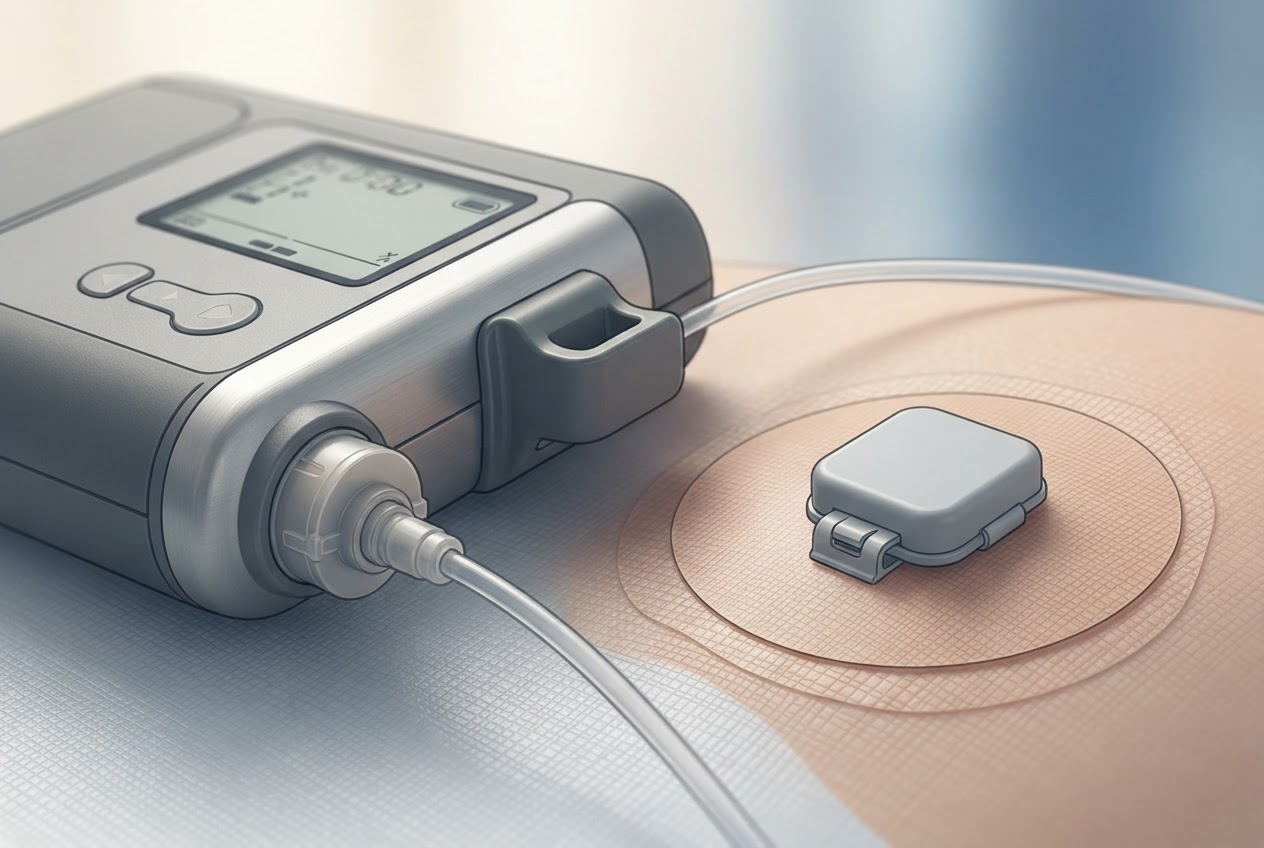
Automated insulin delivery means that a pump adjusts insulin based on the readings of a glucose sensor. With common hybrid systems, users still have to factor meals into the insulin dose calculation themselves. New approaches to prevention and individually tailored treatment are also being evaluated. For some of these approaches, however, evidence or approval for routine care is still lacking.
Type 2: Treating the Heart and Kidneys Too
The 2025 DDG practice recommendations pay more attention to whether people with diabetes also have heart or kidney disease. The HbA1c value shows longer-term blood sugar and remains important. However, when choosing a treatment, the personal risk of heart failure and kidney damage also matters.
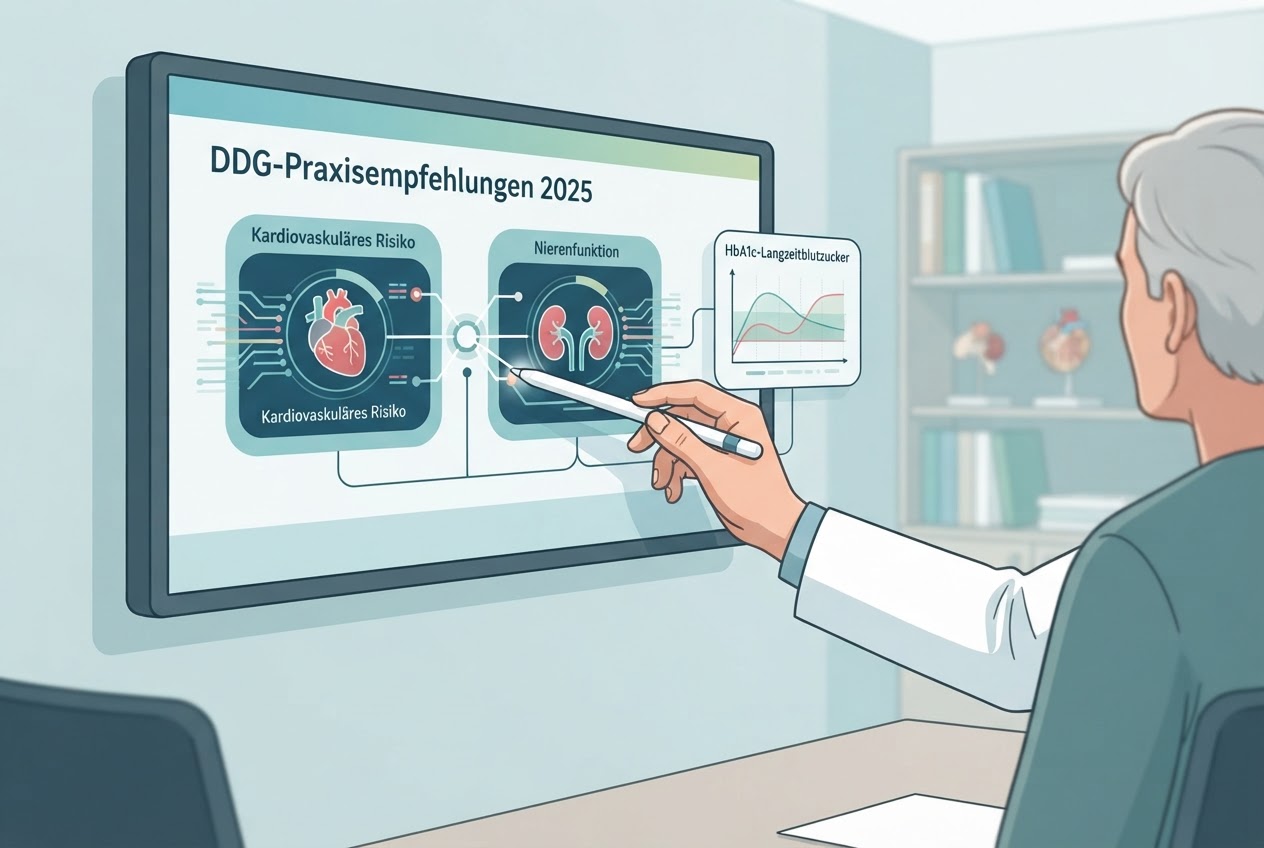
If comorbidities are present, drugs from the SGLT2 inhibitor and GLP-1 receptor agonist classes may be considered, depending on the situation. The updated recommendations also address the combination of empagliflozin with finerenone in diabetic kidney disease. This does not amount to a blanket recommendation for a particular combination; whether a drug is suitable depends, among other things, on comorbidities and the individual treatment situation.
An analysis of treatment data from people with type 2 diabetes and at least one heart or kidney disease at University Hospital Essen shows a gap between recommendations and care. During the observation period from 2019 to 2024, 34.2 percent received treatment classified as guideline-compliant for protecting the heart and kidneys, using an SGLT2 inhibitor and/or a GLP-1 receptor agonist. The share rose over time from 10.2 to 48.7 percent. Women and older people received such therapies less often. Because the study analyzed data from a single university hospital, no nationwide prescribing rate can be derived from it. Nor does it clarify the reasons for the differences observed.
A concrete question is therefore useful for the treatment consultation: What role do heart and kidney diseases play in the choice of my diabetes medication? The answer must take into account personal risks, other conditions and the suitability of individual drugs.
Type 1: Benefits and Limits of Insulin Pumps
A systematic review analyzed 46 randomized trials on outpatient treatment. The researchers compared the treatments using a network meta-analysis, a method that also allows indirect comparisons. With advanced hybrid systems for automated insulin delivery, time in the target glucose range was on average 24 percent higher than with conventional pump therapy. HbA1c and time with elevated glucose levels also improved. The demonstrated difference in time with very low glucose levels, by contrast, was small. Time in range therefore increased by 24 percent in relative terms, not by 24 percentage points.

Real-world data add safety questions to this picture. An analysis of data from young people with type 1 diabetes at 250 centers in Germany, Austria, Switzerland and Luxembourg compared hybrid closed-loop systems with pumps without automated adjustment. With the hybrid systems, the rate of hypoglycemic comas was lower. HbA1c was somewhat lower and time in range was longer. At the same time, the rate of diabetic ketoacidosis was higher: 1.74 versus 0.96 events per 100 patient-years.
Because the analysis observed routine care, it does not prove that the technology itself causes the higher ketoacidosis rate. It does show, however, why good glucose values alone do not give a complete picture of safety. Anyone using an automated system should also discuss with their treatment team what to do in the event of technical problems, interrupted insulin delivery or rising ketones. Switching to such a system does not replace training and ongoing support.
Prevention: Long-Term Data from the US
A long-term analysis of the US Diabetes Prevention Program, published in 2025, covered a follow-up of about 21 years. During follow-up, fewer people in the original lifestyle group developed diabetes than in the placebo group. The same applied to the original metformin group. The median time without diabetes was extended by 3.5 years after the lifestyle intervention and by 2.5 years after metformin.
The results describe groups and do not predict how the course of an individual person will develop. In addition, during follow-up all groups were offered lifestyle programs. The study comes from the US and therefore cannot be directly applied to care in Germany. The DDG points out that metformin is not approved in Germany for the treatment of prediabetes. The long-term data underline the value of prevention; a blanket recommendation to use metformin in prediabetes cannot be derived from them.
Personalization and Digital Services
A classification into five groups, known as diabetes subtypes, is intended to better reflect biological differences and risks. C-peptide, a substance produced during the body’s own insulin production, and the ratio of C-peptide to glucose are considered possible indicators of insulin production. Prospective randomized trials have so far not shown that the classification improves treatment outcomes and is therefore suitable as a fixed rule for choosing therapy. It is thus regarded as a research perspective, not an established standard for choosing therapy.
In 2025, the Federal Joint Committee (Gemeinsamer Bundesausschuss) also approved new digital services for diabetes care. It adopted supplementary digital modules for the disease management programs for type 1 and type 2 diabetes. The modules are voluntary. According to the decision notice, further technical and legal steps were required before the modules could be introduced into care. The decision alone therefore does not prove a nationwide rollout in 2025.
Cell Therapy Remains in the Research Stage
In May 2025, the Robert Koch Institute approved preclinical studies, that is, studies before testing in humans, for the Technical University of Munich using beta cells derived from human embryonic stem cells. Beta cells produce insulin. Among other things, the studies are intended to test safety and efficacy in animals. This also includes the question of whether transplanted cells could form tumors.

The approval concerns research ahead of any possible clinical use. It means neither that a cell therapy was available to patients in 2025 nor that a cure for type 1 diabetes has been achieved.